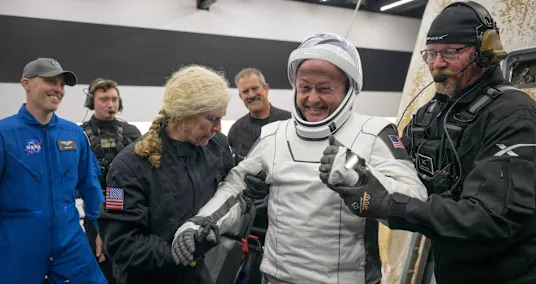
CAPE CANAVERAL, Fla. (AP) — The astronaut who prompted NASA’s first medical evacuation earlier this year said Friday that doctors still don’t know why he suddenly fell sick at the International Space Station.
Four-time space flier Mike Fincke said he was eating dinner on Jan. 7 after prepping for a spacewalk the next day when it happened. He couldn’t talk and remembers no pain, but his anxious crewmates jumped into action after seeing him in distress and requested help from flight surgeons on the ground.
“It was completely out of the blue. It was just amazingly quick," he said in an interview with The Associated Press from Houston's Johnson Space Center.
Fincke, 59, a retired Air Force colonel, said the episode lasted roughly 20 minutes and he felt fine afterward. He said he still does. He never experienced anything like that before or since.
Doctors have ruled out a heart attack and Fincke said he wasn't choking, but everything else is still on the table and could be related to his 549 days of weightlessness. He was 5 ½ months into his latest space station stay when the problem struck like “a very, very fast lightning bolt.”
“My crewmates definitely saw that I was in distress,” he said, with all six gathering around him. “It was all hands on deck within just a matter of seconds.”
Fincke said he can’t provide any more details about his medical episode. The space agency wants to make sure that other astronauts do not feel that their medical privacy will be compromised if something happens to them, he said.
The space station's ultrasound machine came in handy when the event occurred, he said, and he's gone through numerous tests since returning to Earth. NASA is poring through other astronauts' medical records to see if any related instances that might have occurred in space, he said.
Fincke identified himself late last month as the one who was sick to end the swirling public speculation.
He still feels bad that his illness caused the spacewalk to be canceled — it would have been his 10th spacewalk but first for crewmate Zena Cardman — and resulted in an early return for her and their two other crewmates. SpaceX brought them back on Jan. 15, more than a month early, and they went straight to the hospital.
“I’ve been very lucky to be super healthy. So this was very surprising for everyone,” he said.
Fincke stopped apologizing to everybody after NASA's new administrator Jared Isaacman ordered him to stop.
“This wasn’t you. This was space, right?" his colleagues assured him. “You didn’t let anybody down.”
Ever the optimist, he's holding out hope that he can return to space one day.
___
The Associated Press Health and Science Department receives support from the Howard Hughes Medical Institute’s Department of Science Education and the Robert Wood Johnson Foundation. The AP is solely responsible for all content.
LATEST POSTS
- 1
 Golan resident convicted of spying for Iran after passing tank movement, missile-impact data
 - 2German Cabinet advances bill to cut greenhouse emissions from fuels
- 3Vote in favor of the pasta that makes good dieting pleasant!
- 4A coup too far: Why Benin's rebel soldiers failed where others in the region succeeded
- 5April's full moon decides the date of Easter — here's how it works




- Nearly 16,000 New York City nurses prepare to strike as contract talks stall
- A whale stranded at a Baltic Sea resort has swum off a sandbank. But it isn't safe yet
- Kristin Cavallari was the teen queen bee of 'Laguna Beach.' Now she's a 'cringey' mom.
- Sentimental tree to shine at Arctic League annual broadcast
- Chinese fossils reveal a primordial burst of animal evolution
- Orbán orders stop to gas deliveries to Ukraine via Hungary from July
- Bismuth’s haredi draft bill won’t change enlistment, IDI expert tells 'Post'
- Hamas delegation meets Egypt’s spy chief amid mutual ceasefire violation claims
- IDF strikes terror infrastructure across Iran, attack reported on Kashan airport