When you buy through links on our articles, Future and its syndication partners may earn a commission.

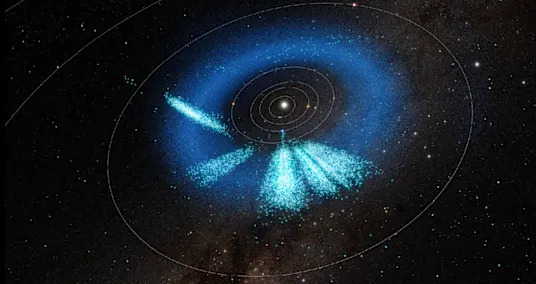
Early observations from the Vera C. Rubin Observatory have already revealed more than 11,000 previously unknown asteroids, reshaping our view of the solar system and offering a striking preview of what's to come once full science operations begin.
The discovery, made using preliminary data, demonstrates Rubin's ability to scan the sky quickly and deeply. Even during limited early observations, the telescope has detected thousands of moving objects in just days, far outpacing traditional asteroid surveys, according to a statement from the NSF NOIRLab.
"This first large submission after Rubin First Look is just the tip of the iceberg and shows that the observatory is ready," Mario Juric, Rubin Solar System Lead Scientist, said in the statement. "What used to take years or decades to discover, Rubin will unearth in months. "We are beginning to deliver on Rubin's promise to fundamentally reshape our inventory of the solar system and open the door to discoveries we haven't yet imagined."
Astronomers currently know of roughly 1.4 to 1.5 million asteroids across the solar system, most of which are concentrated in the main belt between Mars and Jupiter. Rubin is expected to dramatically expand that number, potentially discovering millions of new objects over the course of its 10-year Legacy Survey of Space and Time. The observatory's 8.4-meter mirror and massive camera — the largest ever built for astronomy — allow it to repeatedly image the entire southern sky every few nights, making it uniquely suited to spotting faint, fast-moving objects.
Even in its earliest data, Rubin is uncovering a wide range of asteroid populations. Most of the new discoveries are main-belt asteroids, but the observatory has also identified 33 previously unknown near-Earth objects (NEOs) — asteroids and comets whose orbits bring them close to the sun and are, therefore, of particular interest for planetary defense. However, none of the newly discovered NEOs pose a threat to Earth, according to the statement.
In addition, the telescope has detected more distant and less common populations, including roughly 380 trans-Neptunian objects (TNOs) — icy bodies orbiting beyond Neptune. To find them, scientists developed advanced computational methods that sift through massive datasets, using algorithms to scan millions of faint light sources and test billions of possible motion paths to pinpoint the slow, subtle movements of these distant worlds. Together, these finds offer a more complete picture of the structure and history of the solar system.
"Objects like these offer a tantalizing probe of the solar system's outermost reaches, from telling us how the planets moved early on in the solar system's history, to whether a hitherto undiscovered 9th large planet may still be out there," said Kevin Napier, a research scientist at the Harvard-Smithsonian Center who helped developed the algorithms to detect distant solar system objects with Rubin data.
The recent discoveries extend beyond cataloging. Planetary defense efforts rely on finding and tracking NEOs that could pose a risk to Earth. While many larger objects have already been identified, a significant fraction of smaller — but still potentially dangerous — asteroids remain undiscovered. Astronomers estimate that once Rubin is fully operational, it will increase the number of known larger NEOs from only 40% up to 70% through continuous monitoring. The telescope's ability to revisit the sky frequently will allow astronomers to detect these objects earlier and calculate their orbits with greater precision, improving advance warning capabilities and offering new insights into how asteroids form, evolve and move through the solar system, officials said in the statement.
"Even with just early, engineering-quality data, Rubin discovered 11,000 asteroids and measured more precise orbits for tens of thousands more," Ari Heinze, who helped build the software that detected them, said in the statement. "It seems pretty clear this observatory will revolutionize our knowledge of the asteroid belt."
Current surveys discover tens of thousands of asteroids per year. Rubin, by contrast, has already demonstrated it can find thousands in just a short span of early observations. These first 11,000 discoveries are only the beginning. With Rubin poised to turn the night sky into a dynamic, continuously updated map of moving objects, astronomers are entering a new era of solar system science — one that could both deepen our understanding of our cosmic neighborhood and help protect the planet.
LATEST POSTS
- 1
 Hidden Island Cameras Capture Rare Tasmanian Species for the First Time Ever
 - 2Who was Haytham Ali Tabatabai, Hezbollah's military leader killed by Israel?
- 3L.A.'s most famous midcentury home, the Stahl House, is on the market for the 1st time, at $11K per square foot: See inside
- 4CPA Canada appoints eight directors as new governance model takes effect
- 56 Top Computer game Control center





- UK forecast to face weaker growth and higher inflation from Iran war
- Belarusian parliament passes a bill to crack down on LGBTQ+ rights
- Alleged maple syrup scam in Quebec uncovered by Canadian broadcaster
- Activists guilty over Palestine protest breach
- Must-See Attractions in France
- Vacuum Cleaners That Are Not difficult To Use For Home
- Watch This Glacier Race into the Sea
- 'Outrageous and illegal' : UNRWA slams Israel for cutting off its water, comms and electric in Gaza
- RFK Jr. says fewer flu shots for kids may be 'better.' What experts say.